



Kamran Reza Chowdhury/Dhaka,Bangladesh
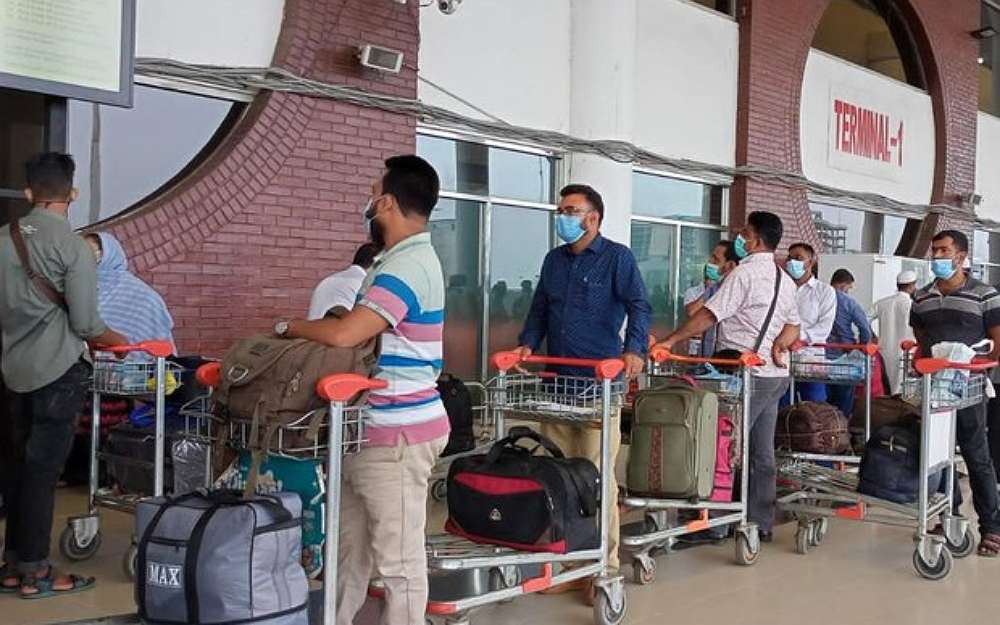
Bangladesh was deprived of nearly U.S. $2 billion in monthly remittances sent via legitimate banking channels because expatriate workers instead used a black market transfer method called Hundi to send money home, the finance minister told reporters on Wednesday.
Minister A.H.M. Mustafa Kamal based his statement on official government figures showing that expats send about $22 billion (2.08 trillion taka) to their loved ones per year – the figure was $2.1 billion for the month of July alone.
“I carried out a study which revealed that 51 percent comes through official channels and 49 percent reaches [Bangladesh] via Hundi. I think that trend is still going on,” Mustafa said while discussing government concerns about Bangladesh’s foreign currency reserves.
Lately, the country’s reserves of the U.S. dollar – the main currency used for international transactions and remittances here – have fallen amid rising costs for imports, high inflation, and other signs of global economic uncertainty. Remittances are among Bangladesh’s most important sources of foreign-currency earnings.
While an NGO official described the figures presented by the minister as credible, two think-tank analysts, however, questioned those numbers. They pointed out this would mean that foreign-based workers send more than $40 billion (3.8 trillion taka) to Bangladesh each year.
What is Hundi?
Hundi allows people to send money from one country to another while bypassing banks and other official channels.
In this process, Hundi agents offer senders exchange rates for currency – in this case takas – that are higher than the country’s official rates.
If a sender agrees to the rate, an agent contacts another agent in the receiving country to deliver those funds to the sender’s designee. Once the funds are delivered, the receiving agent makes a video call to the sending agent to confirm the transaction.
Hundi deprives Bangladesh of getting foreign currencies needed to cover the gap between the cost of imports and export earnings. For the last fiscal year ending June 30, import costs were $97 billion (9.2 trillion taka) against export revenues of $52 billion (4.9 trillion taka), according to the Bangladesh Bureau of Statistics.
“Hundi is not new in Bangladesh. But the volume of Hundi has increased in recent months,” said Syed Saiful Haque, chief of the Warbe Development Foundation, an NGO dedicated to the welfare of migrant workers from Bangladesh.
“One of the causes is the big gap between the exchange rate for taka against the U.S. dollar in the banking channels and the open market,” he told BenarNews on Wednesday.
Haque said banks have been offering an exchange rate of 94 taka for a U.S. dollar, compared to an open-market rate of up to 112 taka.
“We have investigated and found that a big section of the expatriate workers in Saudi Arabia, Iraq, Malaysia, Singapore and other countries have been sending money via Hundi,” he said.
“Digital money transfer systems have made the Hundi traders’ work easier. Now they send money to different destinations very easily and take the foreign currency from the senders,” he said.
In some countries such as Iraq and Libya, some Bangladeshis cannot use regular banks to send money home so they rely on Hundi traders, according to a government official.
Ahiduzzaman Liton, a second secretary at the Bangladesh Embassy in Baghdad, said many of the nearly 70,000 Bangladeshis working in Iraq use Hundi.
“If they send the money through Iraqi banks, the money goes to Bangladesh via banks in Dubai. Again, the remittance charge at the banks is higher in Iraq,” he said.
“The Bangladeshi workers whose work permits expired cannot send money through formal channels so they must depend on Hundi,” Liton said. “It is convenient for the workers as the agents give them better exchange rates.”
Finance minister’s figures questioned
Ahsan H. Mansur, executive director of the private think-tank Policy Research Institute of Bangladesh, cast doubt on the finance minister’s figures.
“If his statement is right, then our actual remittance would stand at nearly $44 billion (4.16 trillion taka) – $22 billion (2.08 trillion taka) coming through formal channels while $22 billion coming through Hundi. The volume of Hundi has increased, but the amount would not be $22 billion,” he told BenarNews.
Despite questioning the figures, Mansur said a big gap between the exchange rates boosted Hundi.
“If the minister’s comments are correct, then this syndrome is a serious matter for us. It means that our system is infested and must be fixed,” he said.
Another analyst expressed similar concerns.
“There is no research on the amount of money transacted through Hundi. Therefore, it is difficult to ascertain whether the minister is correct,” Mustafizur Rahman, a distinguished fellow of the private think-tank Center for Policy Dialogue in Dhaka, told BenarNews.
“The best way to stop Hundi is to narrow the gap between the exchange rates of taka against the U.S. dollar in banks and the open market. People would not go to the Hundi traders when the gap is narrow,” he said.
“A few years back, the exchange rate at the banks and the open market was almost similar. Then we saw a jump in remittance as people shunned Hundi,” he said.
Copyright ©2015-2022, BenarNews. Used with the permission of BenarNews