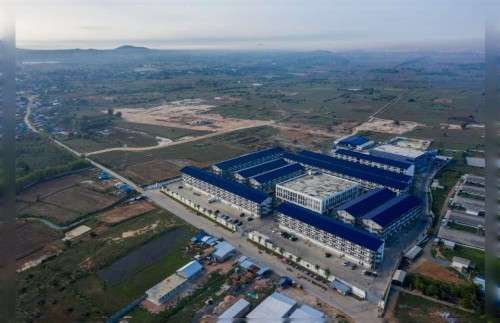





Plans by the Chinese Communist Party (CCP) to begin construction of a new dam and hydropower project on the Yarlung Tsangpo River, which becomes the Brahmaputra River in India and Bangladesh, have sparked concerns over massive environmental destruction, social impact and downstream water shortages, experts have told RFA.
State-owned Power Construction Corp. chairman Yan Zhiyong said the plan to create up to 60 gigawatts (GW) of hydropower capacity was a “historic opportunity” to boost China’s clean energy plan as well as the country’s water supply security, according to the China Energy News, sister publication of CCP paper the People’s Daily.
The CCP has listed “developing hydropower resources on the … Yarlung Tsangpo river” in its Five Year Plan running from 2021-2025. The planned project could have three times the capacity of the controversial Three Gorges Dam.
But environmental groups and Tibetan rights activists said such projects wreak environmental havoc and have a severe impact on downstream water supplies.
“Scientists have warned that constant construction of hydropower dams will lead to earthquakes, landslides and also submerge land and forests under water, which will endanger wildlife,” Zamlha Tenpa Gyaltsen, environmental analyst at the Dharamsala-based Tibet Policy Institute, told RFA in a recent interview.
“It may also lead to either floods in the area or water shortages. The bottom line is it will cause huge environmental destruction,” Zamlha Tenpa Gyaltsen said, adding: “It will seriously impact Arunachal Pradesh and Assam in India, through which the river flows.”
Brian Eyler, Southeast Asia program director at Stimson Center, said details of the dam’s specifications and location are still unclear.
“[This] announcement has already drawn criticism from downstream countries, particularly India,” Eyler said. “Upstream dams on the Brahmaputra impact downstream seasonal hydrological cycles which hold important cultural significance and impact local and national economic activities.”
“This new dam was announced with minimal prior consultation with downstream countries, nothing new for China’s treatment of downstream neighbors,” the Mekong expert said.
Unprecedented downstream impact
Eyler said the Yarlung Tsangpo project was just one part of a massive dam-building program in the upper reaches of the Brahmaputra, Mekong, Yangtze and Yellow rivers that would have an unprecedented impact on everyone downstream.
Yan reportedly said that hydropower construction would help to “develop” Tibet, while the construction of power grids and roads would make cross-border cooperation with South Asian countries easier.
But anti-hydropower groups say China’s rivers are already at saturation point after a dam-building boom that included the construction of the Three Gorges Project and many other giant hydropower plants on the Yangtze and its tributaries.
Zamlha Tenpa Gyaltsen said there could be a more political motive behind the project too.
“I believe that behind these road and hydropower projects, the Chinese government’s main intention is to resettle Chinese people in Tibetan areas,” Zamlha Tenpa Gyaltsen said.
A U.S. government-funded study published earlier this year showed that a series of new dams built by China on the Mekong river had worsened drought in downstream countries, although Beijing disputed the findings, saying it could add up to 350 more gigawatts of hydropower.
The dam has already raised fresh concern in New Delhi.
Jagannath Panda, a research fellow at the Manohar Parrikar Institute for Defence Studies and Analyses in New Delhi, said Indian policymakers say that not enough information is being shared about China’s doings upstream.
“I think it is a genuine concern for India for a long time,” Panda said. “India would ideally expect that China before doing any kind of construction on the dam…will and should consult India.”

China-South Asia trust at low point
He said information shouldn’t be shared selectively, and should be transparent.
“This information and data are crucial for the progress of agriculture for the progress of people’s livelihood,” he said.
Meanwhile, Farwa Aamer, a director at EastWest Institute South Asia program, said trust between South Asian countries and Beijing is currently at a low point.
“A lot of things don’t work out because there is mistrust,” Aamer said. “So anything that one country does out of mysteries the other country is likely going to feel threatened.”
“The concern [from South Asian countries] has always been there,” she said. “[China using the river] as a strategic tool is one thing, but could eventually be weaponized.”
The experiences of downstream countries through which the Mekong runs is a case in point, argues Eyler.
“Data provision [regarding the Mekong basin] is still a trickle of information compared to what is needed to improve outcomes downstream,” he said. “China often doesn’t notify countries of new dam developments on the Mekong: a case in point is the Tuoba Dam on the upper Mekong in Yunnan province which began construction earlier this year with zero notification.”
11 Mekong dams
He said China’s 11 Mekong dams had had a severe impact on hydrological cycles downstream, restricting the water flow at times of drought.
“China’s official discourse on these actions is that upstream dam restrictions prevent floods downstream and reduce drought by releasing water when needed,” Eyler said. “But … there is absolutely zero evidence that China’s upstream regulations reduce floods and improve drought conditions.”
Along the Brahmaputra, there is further cause for worry.
A recent study published by the scientific journal Nature Communications found that destructive flooding will probably happen along the river even more frequently than previously thought, owing to a miscalculation of the baseline in recent years.
United Nations figures showed that around 30 million people in Bangladesh were exposed or living close to flooded areas during July 2020.
China controls the upstream waters of seven huge rivers: the Indus, Ganges, Brahmaputra, Irrawaddy, Salween, Yangtze and Mekong, which flow into Pakistan, India, Bangladesh, Myanmar, Laos and Vietnam.
According to the Lowy Institute, some 718 billion cubic meters of surface water flows out of the Tibetan plateau and the Chinese-administered regions of Xinjiang and Inner Mongolia to neighboring countries annually, with 48 percent of it flowing into India.
Reported by Jane Tang for RFA’s Mandarin Service. Translated and edited by Luisetta Mudie.
Copyright © 1998-2020, RFA. Used with the permission of Radio Free Asia, 2025 M St. NW, Suite 300, Washington DC 20036. https://www.rfa.org
UN Permanent Representative of Iran Briefs Press

Malaysian Man Holds Record for Having Most Teeth in His Mouth

Identify the Dog Breed

Fileless Malware
UN Security Council Meets on Energy, Critical Minerals, and Security

Just Before it Collapses, New Jersey Police Rescue Dog from Burning House

Ragdoll Cats

Process Hollowing
Subscribe Our You Tube Channel

Fighting Fake News
Fighting Lies