



Authorities are encouraging Uyghurs to return to mosques to alleviate repression accusations.
By Shohret Hoshur for RFA UYghur
Most Uyghurs in Xinjiang have not returned to mosques that Chinese authorities have reopened for limited religious services in response to heavy international criticism of repressive policies targeting the mostly Muslim ethnic group, sources inside and outside the country say.
Authorities in the restive northwestern region began scaling back their crackdown on religion in early 2020 by reopening some mosques they previously shut down during the height of religious persecution in 2017.
The change occurred after the United States and the parliaments of some Western countries declared China’s repression of the Uyghurs, including arbitrary detainment and serious human rights violations, amounted to genocide and crimes against humanity. In late August, the United Nations human rights chief issued a report into the accusations and concluded that the repression “may constitute international crimes, in particular crimes against humanity.”
Despite the “softened” stance toward Islam in Xinjiang, most Uyghurs who lost confidence in China’s religious policy that officially recognizes five religions, including Islam, because of the crackdown, have refrained from returning to the reopened houses of worship.
“After being criticized by the international community over the concentration camps, China defended itself by partially relaxing religious restrictions,” said Ilshat Hassan Kokbore, a political analyst based in the United States and vice chairman of the executive committee of the World Uyghur Congress.
“However, since those who were taken to the camps have not been released yet, the residents did not believe in this ‘softening’ of the policy,” he said.
Fear that religion could be used to drive separatism
The Chinese government recognizes five faiths —Buddhism, Catholicism, Daoism, Protestantism and Islam — but has long feared that foreigners could use religious practice to induce separatism.
Under President Xi Jinping, the Chinese Communist Party has focused on Sinicizing religions to conform with the doctrines of the officially atheist party and the customs of the majority Han Chinese population.
But Beijing views expressions of Islam in Xinjiang as extremist because of former independence movements and occasional violent outbursts in the region.
In 2017, Xinjiang’s government implemented an anti-extremism law and began arbitrarily detaining Uyghurs in “re-education” centers in an effort to eliminate “religious extremism” and “terrorism.”
Authorities also assigned party cadres to stay in Uyghur homes to monitor the behavior of the inhabitants and destroyed many mosques across the region, claiming they were structurally unsafe. They also hauled away Muslim imams and religious scholars as part of the crackdown.
Right to practice
But there have been some attempts to loosen controls.
In January 2020, authorities Korla, known as Ku’erle in Chinese and the second-largest city in Xinjiang, issued a document informing residents that they had the right to practice Islam. They then tried to persuade them to return to local mosques, said a policeman who declined to be named because he is not authorized to speak with the media.
A member of a mosque management committee told residents that if they believed in Islam, they could perform regular religious activities at a local mosque that can accommodate 100-150 people, he said.
“The residents said they believed in the faith, and some signed their signatures on a document,” the officer told RFA.
But only four or five Uyghur pensioners dependent on government assitance are attending prayer services there, he said.
In Hotan prefecture, known as Hetian in Chinese, authorities have touted upgrades to existing mosques to encourage Uyghurs to return to them.
“Sunny, spacious and clean”
At the Jeymehel Mosque, the prefecture’s propaganda department has used loudspeakers to try to attract worshipers.
The mosque was built in 1848 and was furnished with an air conditioner, water cooler, storage spaces for shoes and other personal items and a fire extinguisher when it was rebuilt in 2019, according to the department’s pre-recorded announcement.
“Our mosque conditions are the best,” said the announcement as heard on a Xinjiang TV broadcast. “It is sunny, spacious, and clean, and the environment is comfortable. This renovation pleased our worshipers,” says a department announcement over loudspeakers with the sounds of Quranic verse in the background.
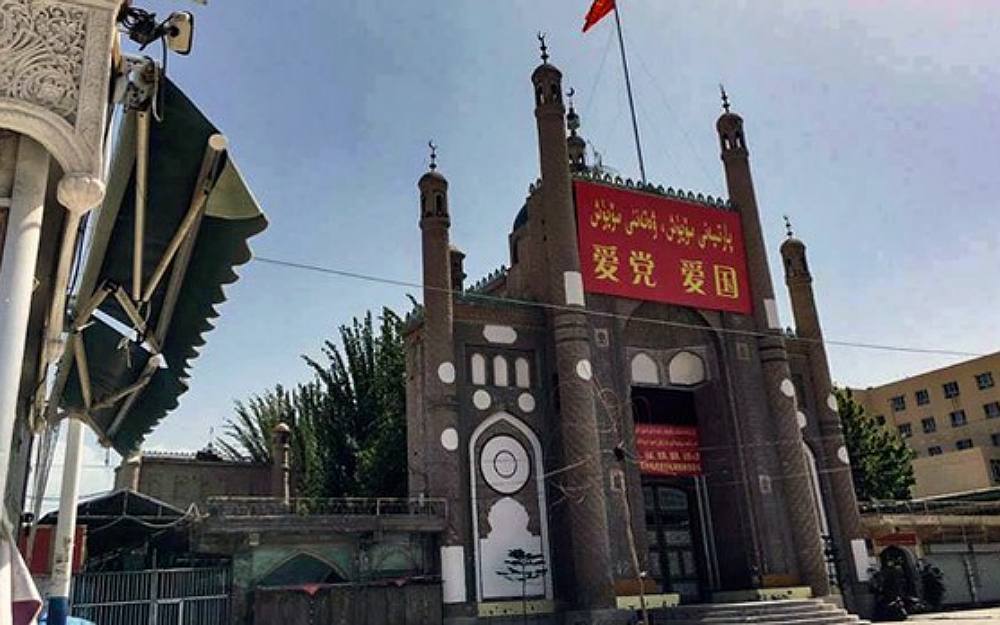
In Kashgar prefecture, known as Kashi in Chinese and an area heavily populated by Uyghurs, authorities turned some mosques into centers disseminating political propaganda, locals told RFA in a 2017 report. They required caretakers of mosques to fly China’s national flag atop the buildings and ordered them to remove Islamic inscription from walls and replace them with large red banners expressing love for China and the CCP.
Authorities previously shut down three mosques in the Chinese Bazar neighborhood of Ghulja, known as Yining in Chinese, and sentenced seven members of Tahtiyun Mosque to prison, sources there said.
Severe clampdown in past
Religious suppression has been severe in Ghulja, recently complicated by a strict lockdown amid outbreaks of the coronavirus this August and September that in some cases led to the deaths of about 90 from starvation or lack of access to medicine in the city of roughly a half-million mainly Uyghurs and other Turkic Muslims.
When the bodies were collected, authorities didn’t inform the families of the deceased about whether they handled their remains according to Islamic burial rituals, according to an earlier RFA report.
Authorities demolished a mosque on Saman Street and locked up another mosque in Ghulja’s Tahtiyun neighborhood and removed its minaret, according to a retired police officer from the Ili Kazakh (Yili Hasake) autonomous prefecture, where Ghulja is located.
They also closed the Tung’gan Mosque, a Chinese Hui Muslim structure, where seven clergymen, including the imam and muezzin, were imprisoned.
A Chinese Hui Muslim imam from Uch’un Hui village in Ghulja was appointed to hold Friday prayer services at a mosque built a decade ago in the town of Qarayaghach, said a security official from the community.
The locals recruited a Chinese Hui Muslim because no Uyghur imams could be found, residents said.
Differing treatment
The Chinese government’s treatment of Muslims differs according to ethnic and geographic lines, sources in the country say. Hui Muslims, who are perceived as less of a threat, are given greater leeway than Uyghurs to practice Islam, such as fasting during the holy month of Ramadan and wearing headscarves, they say.
“The worshipers pray only on Friday [when] they open the mosque,” said the village security chief, who declined to be named for safety reasons.
Four elderly Uyghur residents who receive government pensions went there to worship but had difficulty understanding the imam’s sermon because of his poor Uyghur language skills, which resulted in some words and phrases being almost comically misspoken, village residents said.
But the elders dared not laugh at or express dissatisfaction with him, they said.
One villager said the mosque remains closed on days other than Friday.
“On other days, the security guards watch the mosque,” the person said, adding that the mosque’s loudspeakers are no longer used to call worshipers to prayer, except on Fridays.
Translated by RFA Uyghur. Written in English by Roseanne Gerin. Edited by Malcolm Foster.
Copyright © 1998-2020, RFA. Used with the permission of Radio Free Asia, 2025 M St. NW, Suite 300, Washington DC 20036. https://www.rfa.org.