



Outside experts dispute Chinese historians’ claims it’s from the Tang Dynasty and shows Chinese influence.
By Jilil Kashgary for RFA Uyghur
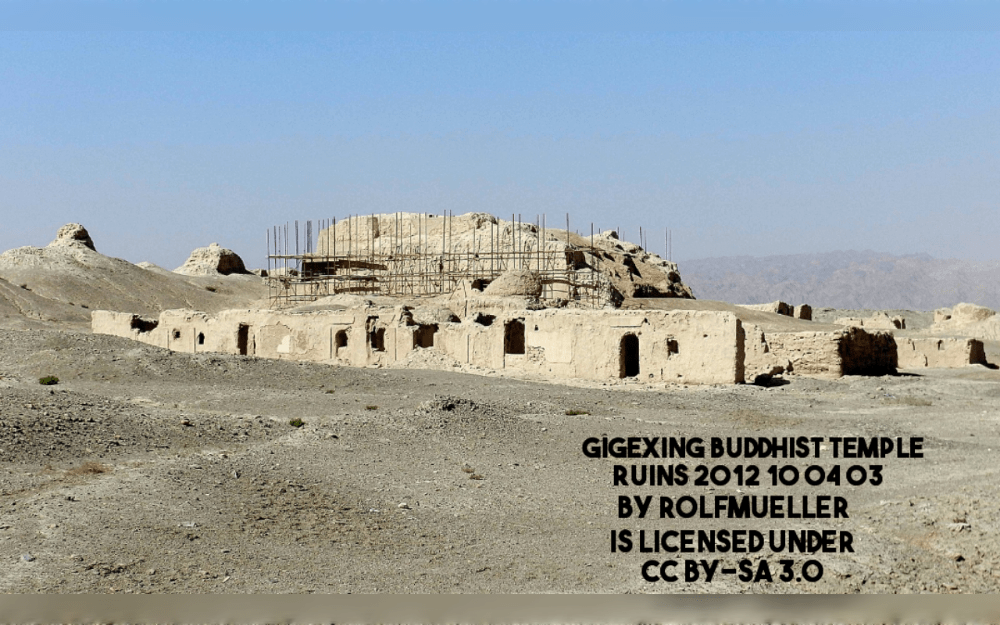
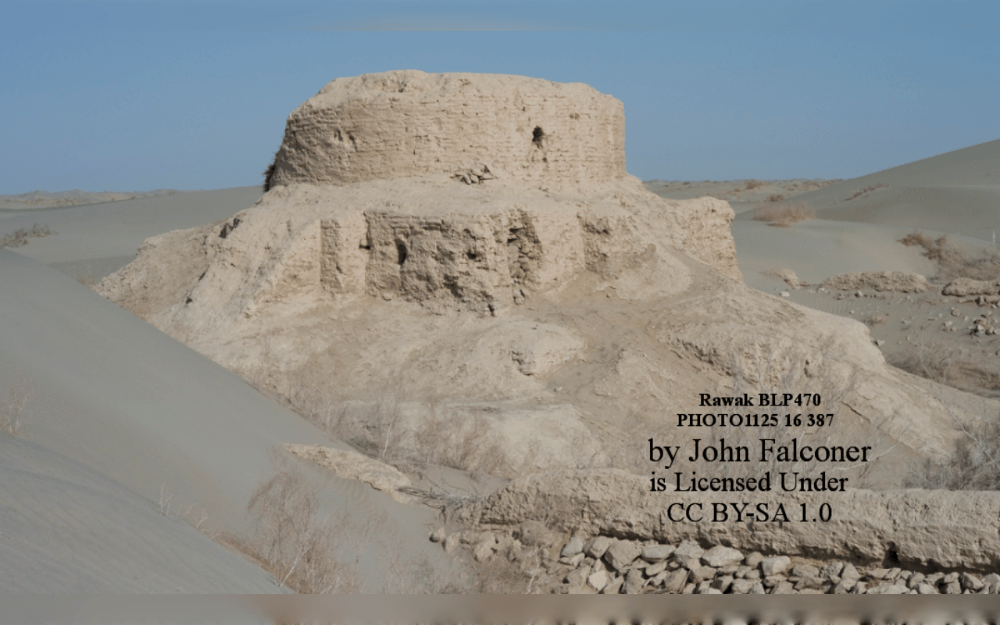
Two earthen pillars, eroded by sand, in barren terrain are all that’s left of an ancient Buddhist temple in the far-western Chinese region of Xinjiang.
Chinese historians and archaeologists assert that a 7th century Chinese empress ordered the construction of the Mor Temple — known locally as Mora, or “chimney” in the Uyghur language — one one of the earliest Buddhist sites in the region.
The ruins show China’s influence in shaping the history and culture of the region — home today to 11 million mostly Muslim Uyghurs — going back centuries, state-run media said.
“They are a powerful testimony to the diversity, unity and inclusiveness of Chinese civilization,” according to a June 3 report by the China News Service.
But experts outside China dispute those claims, saying the Mor Stupa, or pagoda, and other temple structures were built in more of an Indian style.
And it’s highly unlikely that Wu Zetian, empress from 690-705 CE during the Tang Dynasty, was involved in the construction of pagodas because it was hundreds of miles away from her court in central China, they say.
Instead, the Chinese government-backed research may be driven more by Beijing’s efforts to expand its cultural influence in the region, where it is actively seeking to Sinicize Uyghur culture and Muslim practices, they said.
“Empress Wu, the famous female emperor of that time, was avidly promoting Buddhism but not necessarily was she promoting it out in Xinjiang,” said Johan Elverskog, a professor of history at Southern Methodist University in Dallas, Texas, and author of the book A History of Uyghur Buddhism.
“There is no way that the Tang was involved in building things that far to the west,” he said.
Before Islam
Before Islam arrived in China in the 7th century, Buddhism did flourish in what China today calls Xinjiang, or “New Territories” — but which the Uyghurs refer to as East Turkistan, the name of the Uyghur nation that briefly existed in the mid-20th century.
Western archaeologists and Buddhism researchers believe that Buddhism began to spread to Xinjiang during the Kushan Empire, which controlled the western and northern Tarim Basin in southern Xinjiang and ruled over parts of what is today Afghanistan, Pakistan and India between the 1st century BCE and the 3rd century CE.
Some historical documents show Buddhism spread to the region from Afghanistan and northern Pakistan, Elverskog said, while other documents indicate that the Kingdom of Khotan, in present-day Hotan, adopted Buddhism as the official state religion in the 2nd and 3rd centuries.
Archaeological digs at the Mor Temple — about 30 kilometers (19 miles) northeast of Kashgar — since 2019 have determined that the original complex was built in the 3rd century, according to the China News Service report.
It said that elements of Chinese architecture appeared between the 7th and 10th centuries, indicating the prevalence of Chinese Buddhism.
Artifacts discovered around the site reflect Indian and Central Asian Buddhist traditions as well as the influence of the Central Plains, an area along the Yellow River that is believed to be the cradle of Chinese civilization, it said.
But Elverskog said that while there was a Chinese military presence in the region during the Tang Dynasty (618-907 CE), no Buddhist temples were built.
‘United’ by Chinese culture
The idea that Uyghur culture, including its ancient Buddhist history and structures, should be supplanted by Chinese culture was summed up in a speech by Pan Yue, head of the State Council’s National Ethnic Affairs Commission, at an international forum on Xinjiang’s history and future held in June in Kashgar.
“Although Xinjiang’s culture is diverse, it exists in unity, and the most important factor that unites them is Chinese culture,” said Pan, who has been in his role since June 2022.
“Xinjiang should be studied from the perspective of the common history of the Chinese nation and the multipolar unity of the Chinese nation, and Xinjiang should be understood from the perspective of a region where many cultures and religions coexist and ethnic groups live together,” he said.
Kahar Barat, a Uyghur-American historian known for his work on Buddhism and Islam in Xinjiang, said there was “absolutely no Chinese influence” in the Buddhist culture of places like Kashgar and Kucha, another city that once had many Buddhist temples.
He said Kashgar and Kucha were part of the Hindu-Greek Gandhara Buddhist culture that existed in present-day Pakistan from the 3rd century BCE to the 12th century CE.
“They call it the Gandhara art,” he said. “It’s the Gandhara culture created by the Buddhism developed in Kashmir and Pakistan. Therefore, the Buddha paintings and temples in Hotan, Kashgar, Kucha have the influence of Gandhara culture.”
Furthermore, Buddhist temples during the Tang Dynasty were modeled after those in India, making it an exaggeration to say that the Mor Stupa and other temple structures reflected the architectural style of that era, he said.
“Pavilion-style construction is a style of India Buddhism,” he told RFA. “Hence, all the pavilions in China are inspired by these styles. The building styles in the Han Dynasty were later influenced by Buddhist vihara-style construction.”
Elverskog agreed that the Mor Temple was built in Indian style.
“It’s obviously based on precedence in northwest India,” he said. “That was the main source of the Buddhist culture in Hotan and particularly coming from India. … So the Buddhism, the iconography, the artwork, was heavily based on northwestern Indian models.”
Xia Ming, a political science professor at the College of Staten Island in New York, said China’s interpretation of historical Uyghur Buddhism as part of Chinese Buddhism shows the tendency of the Chinese Communist Party to seek its current legitimacy from Chinese dynasties dating back thousands of years.
“If you look at the thousands of years of Chinese history,” he said, “you will see that the Chinese Communist Party will pick and choose any historical node and talk about it if it is useful to them.”
Edited by Roseanne Gerin and Malcolm Foster.
“Copyright © 1998-2023, RFA.
Used with the permission of Radio Free Asia,
2025 M St. NW, Suite 300, Washington, D.C. 20036.
https://www.rfa.org.”