



Authorities are hiring food delivery workers as auxiliary police to monitor Tibetans.
By RFA Tibetan
Since early August, Chinese authorities have dramatically boosted surveillance of Tibetans in the Tibetan capital of Lhasa by putting more police on the streets, cracking down on social media users and – in a new wrinkle – hiring food delivery workers to serve as auxiliary police officers, sources inside Tibet say.
The increased monitoring activities coincided with the start of a major annual festival, the Shoton Festival, on Aug. 4. Also known as a yogurt festival, it is observed when monks complete their annual religious retreats and involves the unveiling of a 500-square-meter thangka painting, performances of Tibetan opera and huge picnics.
“The government has been taking various measures to tighten its vigilance in response to sensitive situations in Tibet, but this August, it has suddenly taken even more drastic measures,” said one source from inside Tibet.
Authorities are calling it a “summer public security crackdown and rectification operation,” the sources said.
The precise reasons behind the stricter measures – which continue – are not known, but Beijing has steadily tightened surveillance in Tibet over many years. One source said the measures were to ensure stability for the government’s commercial activities to stimulate economic growth.
That may be true on the surface, but comments from a senior security official point to a deeper motive. Zhang Hongbo, vice chairman of the Tibet Autonomous Region and director of the Public Security Department told state media that security forces would focus on national unity and fight separatism or secession.
Tibet was once an independent country, but Chinese forces invaded in 1950 and have controlled the territory ever since. The Dalai Lama fled into exile in India amid a failed 1959 uprising against Chinese rule. Since then, Beijing has sought to legitimize Chinese rule through the suppression of dissent and policies undermining Tibetan culture and language.
Authorities are hyper-sensitive to any hints of protest against Chinese rule or resistance to those efforts.
Here are three ways that authorities are boosting surveillance in Lhasa:
One: Greater police presence on the streets.
This includes plainclothes officers, and an increase in the number of traffic and police inspection points.
Lhasa’s Public Security Bureau deployed more than 1,200 police officers, set up 65 inspection and traffic checkpoints and conducted inspections of more than 2,000 venues and 24,000 vehicles, according to a Chinese state media report on Aug. 5.
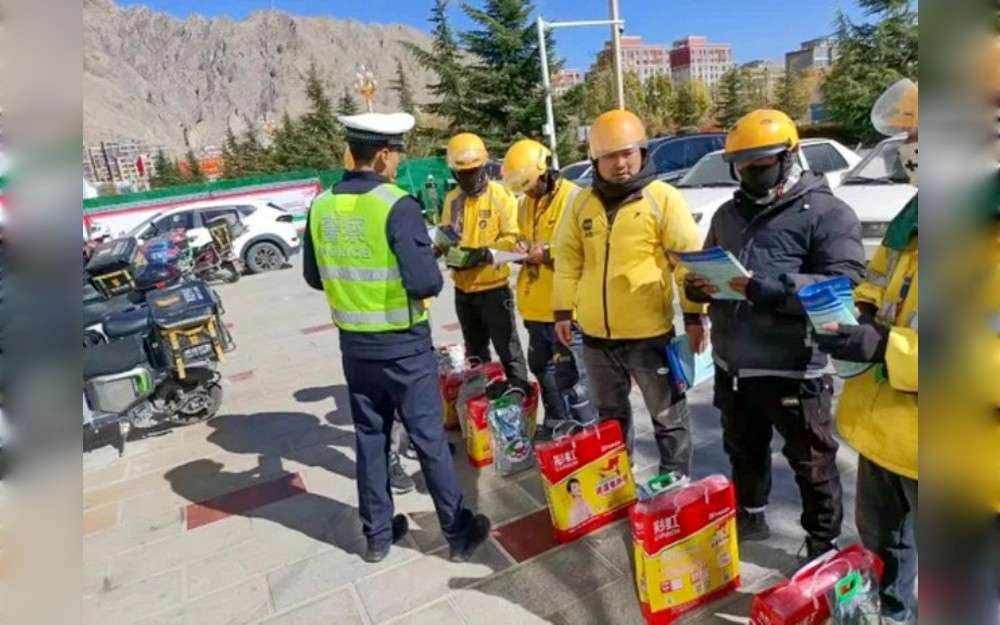
Two: Authorities have deployed civilians – mostly food delivery drivers – as auxiliary police officers.
Lhasa authorities launched a pilot program hiring delivery drivers from food delivery company Meituan to perform “voluntary patrol and prevention work,” Chinese state media reported on Aug. 8 – although sources say the workers are essentially forced to do the work.
They are helping police to keep an eye on ordinary residents, including serving at night watchmen in certain areas.
The measure suggests China is using Tibet as a testing ground for its surveillance tactics because they are similar to civilian-police integration efforts China employs in border areas, said Sriparna Pathak, associate professor of China studies at the O.P. Jindal Global University in Haryana, India.
China has set up civilian-police integrated units in sensitive border areas of the Xinjiang Uygur Autonomous Region and the Tibet Autonomous Region, both in the far western part of the country. The units comprise civilians, policemen, militiamen and government officials working with People’s Liberation Army soldiers to ensure security.
“China’s efforts to rope in delivery riders for surveillance is in line with the effort to further consolidate its grip in Tibet,” said Kalpit Mankikar, an expert at the New Delhi-based think tank Observer Research Foundation.
Hiring Meituan delivery workers for surveillance also signals a link between the Chinese government and private enterprises, showing how the government drafts companies to fulfill certain national objectives, Mankikar said.
Three: Crackdown on social media use among Tibetans.
In the past, Tibetans could sign up for social media with only a phone number.
But at the end of July, the government announced that social media users had to re-open their accounts and provide personal details, the sources said.
Re-registering involves providing a password connected to one’s personal cell phone or identity card that is accessible to the government, one of the Tibetans said.
“If you do not have proper social media account registration, you will receive a summons from the government to re-register, and your phone will be examined,” one of the sources said.
Authorities also began stopping individual Tibetans in Lhasa to check for use of virtual private networks, or VPNs, that allow users to get around China’s internet restrictions, often dubbed “China’s Great Firewall,” two sources from inside Tibet said.
In early August, authorities in Lhasa arrested three people for using a VPN but released them with an administrative punishment, the Municipal Public Security Bureau said on its website.
The government said the latest measure was meant to protect personal data information, properly manage internet society and prevent telecommunication network fraud.
Lhasa police said Tuesday that it was inspecting the entire internet network and city streets for two days and nights to ensure public safety and security.
This comes on top of authorities’ strict monitoring of Tibetans’ use of social media, including Douyin, China’s version of TikTok.
Authorities have banned Tibetans from using the Tibetan language on social media sites – part of an effort to undermine their language and assimilate into Chinese culture.
Additional reporting by Dickey Kundol, Tenzin Dickyi and Yangdon for RFA Tibetan. Written and edited by Tenzin Pema for RFA Tibetan. Edited by Roseanne Gerin and Malcolm Foster.
“Copyright © 1998-2023, RFA.
Used with the permission of Radio Free Asia,
2025 M St. NW, Suite 300, Washington, D.C. 20036.
https://www.rfa.org.”